30 September 2026 — Ramzi Chamat
Mortgage Rates in Geneva: Outlook for 2027
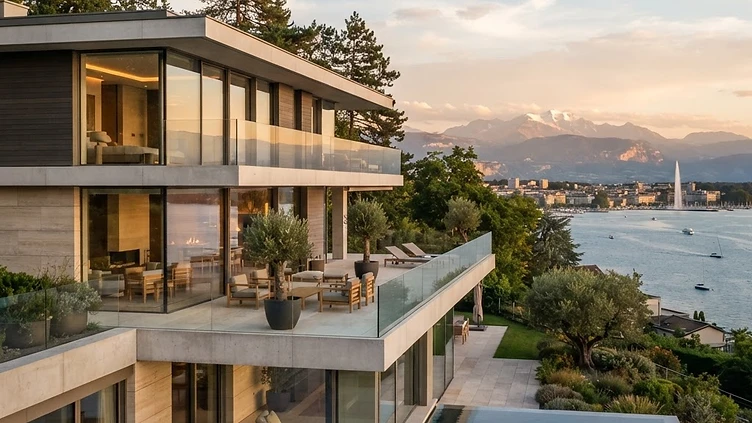

The Geneva real estate market is navigating a unique monetary environment in 2026. While the Swiss National Bank (SNB) confirmed on September 24, 2026, that it would maintain its policy rate at 0% [2, 6], industry participants are observing a complex dynamic where mortgage rates no longer move in lockstep with central bank decisions. For property owners and investors in Geneva, understanding this decoupling is essential for anticipating transactions in 2027.
The SNB's Monetary Policy in 2026
The SNB’s strategy remains focused on price stability and controlled inflation. During its assessment on September 24, 2026, the institution reiterated its commitment to a 0% policy rate [2, 6]. This policy aims to support a Swiss economy with projected GDP growth between 1.5% and 2% for 2026 [6]. However, this apparent stability masks a more nuanced market reality, where capital market expectations are already influencing long-term financing conditions [4, 9].
Decoupling: Why Are Fixed Rates Rising?
It is notable that despite the zero policy rate, fixed-rate mortgages have shown an upward trend, recently exceeding the 2% threshold in some market segments [8]. This phenomenon is driven by rising long-term capital market rates, which react to global economic outlooks rather than solely to SNB decisions [4, 9].
- Fixed rates incorporate a risk premium linked to global economic uncertainties [4, 9].
- Persistent demand for housing in Geneva, coupled with structurally limited supply, maintains upward pressure on prices [4, 5].
- Banks are adjusting their margins based on refinancing costs in bond markets [4].
2027 Outlook: A Shift in the Cycle?
While the status quo prevails for now, financial markets are beginning to anticipate a potential monetary shift for 2027 [6]. Although the SNB favors caution, some analysts do not rule out a gradual normalization of rates if the economic environment remains robust [3, 6]. For Geneva buyers, this means borrowing costs could follow a moderate upward trend, potentially impacting borrowing capacity and transaction dynamics next year [4, 9].
Impact on the Geneva Real Estate Market
In Geneva, the scarcity of properties remains the primary driver of prices. The rise in mortgage rates, while real, has not triggered a sharp correction in sale prices due to insufficient supply [4, 5]. Investors and families must now integrate more precise financing strategies, weighing the flexibility of the SARON—which is expected to track SNB policy in 2027—against the security of fixed rates [4, 9].
Key Takeaways
The Geneva real estate market is in a transition phase. While the SNB maintains a 0% policy rate in 2026 [2, 6], the cost of fixed mortgages has already risen, reflecting tensions in capital markets [4, 9]. For 2027, caution is advised: markets anticipate a rate increase, which could influence transaction volumes and asset valuations across the canton.
Frequently Asked Questions
Why are mortgage rates rising when the SNB rate is 0%?
Fixed mortgage rates depend on long-term capital market rates, which anticipate future economic developments, unlike the SNB policy rate which primarily influences short-term rates [6, 9].
Should I choose a SARON or fixed-rate mortgage in 2027?
The choice depends on your risk tolerance. The SARON remains correlated to the SNB policy rate, while a fixed rate offers protection against rising market rates, albeit at a higher current cost [4, 9].
How does SNB policy affect property prices in Geneva?
Low rates have supported demand, but the housing shortage in Geneva remains the dominant factor preventing price declines, despite the increased cost of credit [4, 5].
Sources
- Swiss National Bank (SNB), Monetary policy assessment, September 2026 [2, 6].
- PostFinance, Interest rate forecast and development, 2026 [1, 6].
- Resolve, Swiss mortgage market reports Q1 & Q2 2026 [4, 9].
- Alpian, Interest rates in Switzerland, 2026 [5].
- Schwiizerfranke, Historical mortgage trends, 2026 [8].